
Who gets to check AI’s invisible ink?
A document changes hands. Its hidden mark may travel with it, while access to checking that mark stops at a gate. What can an editor actually establish?

An editor receives a notice that reads perfectly normally. Someone wrote it, someone may have polished it, and now it needs publishing. A promise that the writing tool leaves an invisible mark sounds useful. The next question is whether the person receiving the words can check it.
The copy arrives without its family tree
The Borrowed Lamp is our fictional workshop notice: twelve places, borrowed tools, an entrance with two steps. It is ordinary enough to pass from a writer to an editor, then into a newsletter. Those details make the publishing decisions visible. Who checked the price? Who accepted the wording about access?
We retained the starting notice, openly drafted with Codex. It is an AI-assisted illustration, with an intentionally uncorrected grammar error. The proofreading and rewriting requests in our declared protocol remain unperformed; no current-provider text detector has checked it. This gives us a document to follow, without dressing an intended experiment as a result.
The useful distinction begins before any detector. The writer can keep the request and original output; the editor can keep the changes. A final paragraph can be beautifully tidy while its family tree is a mess.
One notice, four evidence questions
Writer
What request produced these words? Retain the starting version and its declared AI assistance.
Editor
What changed? Preserve revisions and the reasons for accepting them.
Publisher
Who accepted the final wording? Keep the version that actually went out.
Verifier
What can be checked? Obtain the matching tool, exact material and returned finding.
An origin signal has a smaller job than authorship
A text watermark is a statistical pattern in word choices. It is not a visible stamp tucked into the paragraph. Anthropic’s method explanation describes using otherwise ordinary choices between plausible words to leave a pattern that a matching checker can recognise.
That idea has a research history. University of Maryland researchers demonstrated a word-selection watermark and a statistical detector in work first published in 2023. Their experiments used an older OPT model. The paper’s discussion of constrained wording and edits helps explain the problem; it does not validate the accuracy of today’s Claude, OpenAI or Grok systems.
Anthropic’s explanation of proofreading makes the authorship boundary concrete. A mark can appear after proofreading or translation, even when the underlying material came from elsewhere. Detecting processing would not tell our editor who devised the workshop, checked its entrance or decided what to promise. Those are separate parts of making something publishable.
The words and the file part company
Anthropic describes embedded text marks separately from signed file records called Content Credentials. Its free file checker checks Claude-issued credentials; text detection remains in private preview for eligible organisations. A public upload box for files does not provide a public test for pasted words.
The C2PA standard explains what a signed file history contributes: a check on the record’s integrity and its connection to the file. It does not certify that the event depicted is true. A valid record can help an editor follow a photograph’s history while leaving the reporting question open.
Two routes through the same handoff
Follow the material being received before choosing what to check. These are explanatory routes, with no completed check on our fictional notice.
A signal in the words
Keep the passage
The exact words and edit history describe what is being checked.
Reach the matching detector
Provider access and the detector’s scope come before a returned result.
Read the scoped finding
A result concerns a supported mark. It does not reconstruct every contributor’s decisions.
Text marking and access ↗ · Checked 6 November 2026
A signed history attached to a file
Keep the original file
A credential belongs to a particular asset and its recorded history.
Validate the credential
Check the signature, trust and connection between the record and that asset.
Continue the reporting
An intact provenance record leaves the truth of the depicted event to be established.
C2PA v2.4 explainer ↗ · Checked 6 November 2026
A newsroom asks the checker again
For an image, Full Fact has already followed a real version of this handoff. Journalist Sian Bayley reported five apparently genuine political images flagged by Google’s SynthID Detector. The team contacted the people who published them and Google. It described likely false positives, while leaving possible inadvertent minor editing unresolved.
Its retained tram-image comparison records two different findings. The first check detected SynthID; the later one returned uncertainty. The tool changed, but the need to establish the image’s history remained. Full Fact did not estimate how often false positives occur. This is its image investigation, separate from our fictional text example.
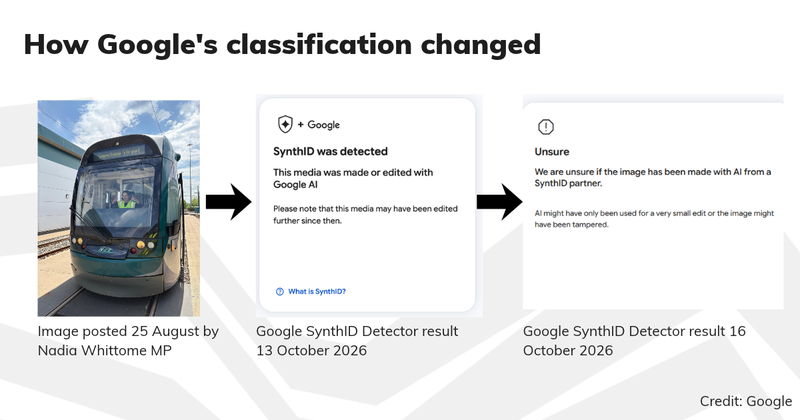
One image, two returned findings
The original post
Nadia Whittome’s tram photograph was posted. This is the source date, not a detector check.
Original source ↗A reported tool update
Full Fact reports that Google rolled out changes after it raised the findings.
Original source ↗“Unsure”
The second retained check returns uncertainty. It does not certify human origin.
Original source ↗
The gate comes before the finding
That leaves our editor with a practical access question. OpenAI’s 5 October announcement opened applications for a text detector initially limited to approved researchers and expert organisations. Selected API models could opt in to marking worldwide, off by default. Eligible EU ChatGPT and Codex output was described as a phased rollout over the following weeks. That dated plan alone does not establish which individual passage is marked today.
Anthropic likewise lists eligible organisations for its text-detection preview. Its marking support varies by model and surface; the current table still schedules completion of some Bedrock rollouts by 10 November. Eligibility is not a detector result, and a file checker does not remove the text-access gate.
The distinction also appears in Grok’s API documentation. It schedules default marking for listed models from 7 November, tomorrow at this reporting date. A response header can record whether generation used watermarking. That is useful evidence from the sender’s side; it is not a later detector finding on edited copy.
Leave room for an unfinished answer
Our editorial view is that provenance becomes more useful when it travels as a record of decisions, rather than a verdict squeezed into a badge. The detector’s exact words, the version checked and the date belong together. “We could not run the check” and “the check was uncertain” tell the next editor different things.
For the fictional notice, the present state is simply not checked. We found no eligible retained current-provider text workflow to reproduce in the inspected sources, and obtained no detector result ourselves. The open question is what happens when an eligible publisher retains the original passage, its edited version and the actual returned findings.
An editor still has work to do in the meantime: follow the source, identify the changes and take responsibility for the copy that reaches a reader. Invisible ink may add a useful clue. It cannot sign off the workshop’s opening time.
Three states worth keeping separate
Not checked
No check was performed or access was unavailable. No detection finding exists.
Inconclusive
A checker returned uncertainty or insufficient evidence. Preserve its actual wording.
Scoped finding
A check returned a finding about a supported mark, for the exact material and conditions recorded.
Sources & reporting
Checked 6 Nov 2026. This perspective combines reporting from the sources below with our editorial interpretation.
- How Claude marks AI-generated content ↗Anthropic Help Center · Documentation
- How Claude’s text watermark works ↗Anthropic · Documentation
- Our approach to EU text provenance rules ↗OpenAI · Announcement
- Output watermarking: dated API scope and generation header ↗SpaceXSI / xAI documentation · Documentation
- Google updates AI detector after Full Fact investigation finds it flagging apparently real images ↗Sian Bayley · Full Fact · Research
- Retained tram-image checks, 13 and 16 October ↗Full Fact · comparison graphic · Research
- A Watermark for Large Language Models, version 4 ↗Kirchenbauer et al. · University of Maryland · Research
- C2PA and Content Credentials explainer, version 2.4 ↗C2PA · Documentation
- The Borrowed Lamp: fictional Codex-authored starting notice ↗Marketer Fizz · retained reporting material · Research
- Declared revision protocol and evidence states; revisions unperformed ↗Marketer Fizz · reporting protocol · Research
Written with AI assistance. Fizzy is our fictional reporter persona. Our editorial approach.