
Europe’s AI Act meets the synthetic feed
From Barcelona’s Aitana López to lifelike video characters, Europe’s AI law is moving from institutions into the feed. What changes when an influencer looks human but isn’t?

Europe spent years negotiating rules for artificial intelligence. During that time, the technology learned to do something unusually persuasive: produce people who appear to have lives. They pose at real events, speak into a camera, accumulate followers and offer recommendations. The EU AI Act is now meeting that synthetic feed. Its test is whether people can understand what they are watching before they decide whom to trust.
The promise Europe made
When the Commission proposed the AI Act on 21 April 2021, it was trying to govern a technology through its uses and risks. Hiring software, credit decisions, public services and biometric surveillance were central concerns. Margrethe Vestager, then the Commission’s executive vice-president for the digital agenda, put trust at the centre of the proposal:
“On Artificial Intelligence, trust is a must, not a nice to have.”
Margrethe Vestager, announcing the Commission proposal in April 2021 ↗
The law that emerged does not treat a spam filter, a recruitment system and a realistic AI presenter as the same problem. Certain practices are prohibited; specified high-risk uses face stronger controls; other uses require transparency. General-purpose models—the underlying models used across many applications—also have their own obligations. A large follower count is not itself a legal risk category.
That architecture explains why the AI Act belongs in a story about everyday media. A system can avoid making a loan decision or assessing a job applicant and still change what a person believes. A convincing face, an apparently spontaneous conversation or a scene from a real place can borrow the authority of an encounter that never happened.

The law has a clock. The feed has another.
Parliament endorsed the Act on 13 March 2024, and it entered into force that August. Implementation then arrived in stages. Prohibited practices and AI-literacy duties came first; governance and general-purpose-model rules followed. Content transparency reached its general application date on 2 August 2026.
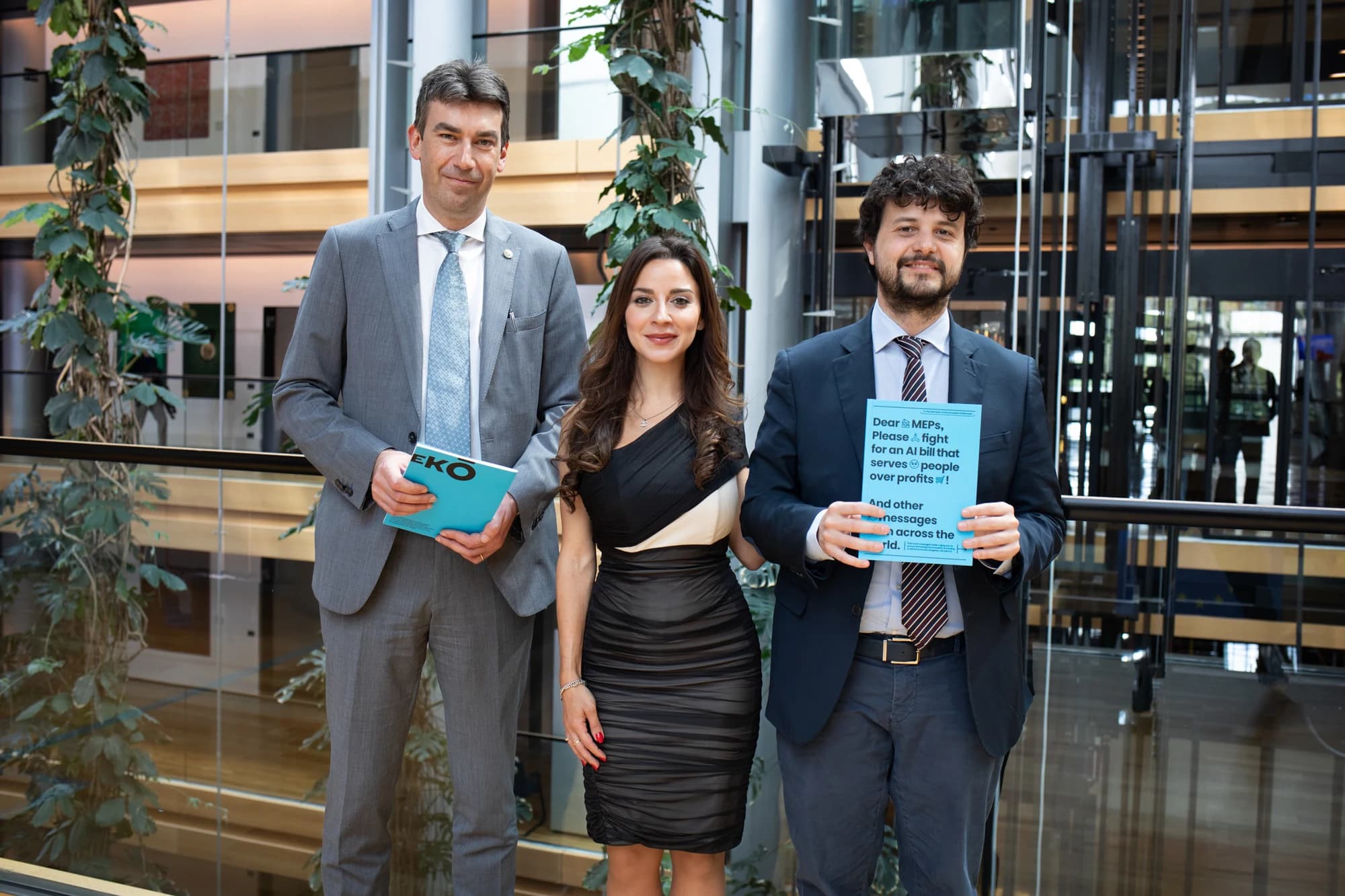
The lengthy process was also a debate about what belonged in the law. In May 2023, campaign group Ekō delivered messages to the parliamentary co-rapporteurs asking for generative AI systems to be included. The photograph below captures that negotiation at a human scale: people arguing over rules for a medium that was still changing.

The July 2026 Omnibus amendment changed parts of the timetable. High-risk-system deadlines moved, while Article 50 retained its August application date. A narrow transition gives providers of relevant systems placed on the market before 2 August until 2 December to meet the output-marking duty. It does not postpone all public disclosure. The timeline shows the difference between a law entering into force and individual duties beginning to apply.
Five years from proposal to the feed
Parliament’s vote
MEPs endorse the negotiated Act. Council approval and formal enactment follow.
Original source ↗The law enters into force
The regulation becomes law; its different duties have separate application dates.
Original source ↗The first duties apply
Prohibited practices and AI-literacy obligations begin to apply.
Original source ↗The underlying models
Governance rules and obligations for general-purpose AI models begin to apply, with their own transitional provisions.
Original source ↗The timetable changes
The enacted AI Omnibus amends the Act, including selected high-risk deadlines and the older-system marking transition.
Original source ↗Transparency reaches the audience
Article 50 generally applies: direct AI interaction, synthetic-output marking and relevant public disclosure.
Original source ↗- Scheduled
The marking transition ends
Providers of relevant systems placed on the market before 2 August must meet Article 50(2).
Original source ↗ - Scheduled
High-risk uses follow
Rules for specified high-risk uses, including employment and education, apply. Relevant product-linked high-risk systems follow on 2 August 2028.
Original source ↗
The people who aren’t people
Aitana López makes the shift concrete. The Barcelona agency The Clueless presents her as a fully AI-generated influencer. Her public Instagram profile frames her around fitness and lifestyle. This is a character developed for an audience, rather than a single generated advertising image. The agency describes her explicitly as AI; that does not tell us how every individual post is received.
Mia Zelu shows how a fictional person can inhabit a real cultural moment. Her July 2025 Wimbledon series presented the familiar ingredients of an influencer visit: fashionable clothes, a London setting and a question about the tennis. ZELU House, the German company that manages her, identifies Mia as an original AI-generated character and now offers her for imagery, film and music. Her profile now points readers to the Endless Summer music release.
The original Wimbledon post is worth seeing in context. It is dated 6 July 2025 and asks which match readers enjoyed. When opened today, Instagram displays an AI-generated profile label. The Independent’s contemporary reporting described an AI disclosure in the biography. The broader question is how much of that context travels with one image when it leaves a profile and appears in somebody else’s feed.
The original Wimbledon-themed carousel, including the question about readers’ favourite match. Observed today with Instagram’s AI-generated profile label.
Open the original on Instagram ↗Post and media © their respective rights holders. The embed loads from Instagram; this link remains available if the embed cannot load.
Video adds another layer. Granny Spills’ profile credits Blur Studios behind the pink-suited advice character. In a November 2025 interview with TIME, creators Eric Suerez and Adam Vaserstein described using Veo and other tools to produce her performances. Her original July video carries a #veo3 tag. This is a documented production example, not a claim that every AI influencer uses the same model.
The original advice-character video linked in TIME’s interview. Its caption identifies Granny Spills and includes #veo3.
Open the original on Instagram ↗Post and media © their respective rights holders. The embed loads from Instagram; this link remains available if the embed cannot load.
Google’s May 2025 Veo 3 release introduced generated sound and dialogue alongside video. That matters because a persona can now arrive as a speaking performance, complete with a setting and timing, rather than only as a polished still. Aitana’s agency page and Mia’s studio materials do not establish which video model made each asset; we should not fill that gap by judging how convincing they look.
Real audiences, incomplete histories
- Aitana López ↗404KInstagram followers · 8 October 2026
Agency-built fitness & lifestyle persona
- Mia Zelu ↗283KInstagram followers · 8 October 2026
Editorial imagery, film & music character
- Granny Spills ↗2.1MInstagram followers · 8 October 2026
Video-native advice character
No comparable dated historical checkpoint verified for this chart.
Jean Phil: the joke, the reach and the reveal
Jean Philanthrope arrives with a blond bob, a curled moustache and the solemnity of a man who has never lost an imaginary fight. In an early Instagram clip, he shadowboxes to French rap, wearing a brown suit. The joke is easy to recognise and easy to repeat. By 25 September, Dexerto reported more than 228,000 Instagram followers; The Tab recorded 235K four days later. When we checked on 8 October, the profile displayed 240K. That shows a substantial audience, but not how many viewers believed he was a real person.
An early shadowboxing performance. Instagram displays 18 September; some contemporary accounts date this clip to 19 September. We retain the date shown by the original platform.
Open the original on Instagram ↗Post and media © their respective rights holders. The embed loads from Instagram; this link remains available if the embed cannot load.
The character also escaped his own feed. SiN’s 20 September X remix puts Jean into another video, a small example of how a distinctive face becomes material for other people’s jokes. Those copies matter: an audience can encounter a persona through a remix before seeing its original profile or any explanation of how it was made. Aitana is presented by an agency; Jean’s circulation is harder to follow back to an accountable author.
How was he made? We did not find a verified operator statement establishing the original model or production process. Kapwing’s Emily Peng has demonstrated a Jean-style recreation using a character reference and motion input with Seedance 2.5. In plain terms, one input supplies the look and another supplies the movement; the model combines them into a new performance. This is a vendor’s reconstruction, not evidence that Jean’s creator used that tool. It explains why a repeatable character no longer requires each scene to be filmed with the same human performer.
The reactions reveal a disagreement about the experience, rather than a single verdict from “the internet”. On the early clip, one commenter describes Jean as artistic expression; on his latest post, another asks viewers to support real people instead of AI accounts. Jeremy Carrasco’s 25 September commentary examined the AI-character and memecoin connection. Separately, an X account using Jean’s name identified a JEANPHIL token on 20 September. That is direct evidence of promotion by that account; it does not establish who operates every Jean account, the original production method or a fraud finding.
The latest post brings the question closer to the other examples in this story. Its 7 October caption invokes Paris Fashion Week and tags Stella McCartney. Neither the caption nor the tag proves attendance, a partnership or sponsorship. But a fictional character situated around a real event can invite viewers to read more into the scene than a joke alone. One response captures the attraction without treating it as a factual encounter:
“I’ve never wanted a person to be real this bad. lol”
polo715, commenting on Jean’s 7 October post ↗
The caption invokes Paris Fashion Week 2026 and tags Stella McCartney. This does not establish a brand relationship or attendance.
Open the original on Instagram ↗Post and media © their respective rights holders. The embed loads from Instagram; this link remains available if the embed cannot load.
This is where the AI Act’s distinctions become useful. An obviously comic performance and an apparently authentic appearance at a real event can create different expectations—even when the face is the same. The Commission’s guidance calls for context to be assessed, including the message and the audience. We are not making a legal finding about Jean. The editorial question is whether the disclosure reaches people at the moment they encounter the performance, including when somebody else reposts it.
Jean’s Instagram audience, at three checkpoints
- Jean Philanthrope ↗240KInstagram followers · 8 October 2026
Short-form character and remix phenomenon
- >228KDexerto ↗ · lower bound
- 235KThe Tab ↗
- 240KPublic profile ↗
A fictional person can still make a real-world claim
The label “AI influencer” is useful shorthand, but it is not the legal test. Article 50 draws a distinction between the provider of a generating system and the professional user publishing its output. Providers must make synthetic outputs machine-readable and detectable, subject to technical feasibility and the law’s qualifications. Professional users must disclose deepfakes—realistic AI-generated or altered media that would falsely appear authentic—and certain AI-generated public-interest text. Those duties answer different questions.
A wholly invented face is not an automatic escape route. The Commission’s July guidelines interpret the deepfake definition to include realistic AI-generated human personas and subjects that could plausibly exist. They also require assessment of the resemblance, the message, the setting and the audience’s expectations. That is Commission guidance on the law, rather than a court ruling on the creators featured here.
The same guidance makes the commercial boundary unusually concrete. Its examples include a realistic synthetic influencer demonstrating a sponsored real product as content that does not qualify for the lighter treatment of artistic or fictional deepfakes. By contrast, an evidently fictional or satirical work can use an appropriate disclosure that preserves the experience. Creativity does not make every product demonstration fiction.
“realistic synthetic influencer testing out a sponsored real product”
An example in the Commission’s Article 50 guidelines, printed page 39 ↗
For a single post encountered in a shared feed, the practical question is what its viewer can understand at that first exposure. The disclosure duty cannot be fulfilled simply by relying on a hidden mark that needs a special tool. A biography, a platform label and a caption each operate in a different viewing context. Checking the context is more useful than assuming that one account-level description settles every future use.
The setting changes the question
Illustrative situations based on the Commission’s guidance—not verdicts on the named accounts.
| What the viewer sees | Why it matters | Relevant distinction |
|---|---|---|
| A realistic synthetic presenter demonstrates a real product. | The performance can imply an authentic demonstration of how the product works. | The guidelines give a synthetic sponsored-product demonstration as an example outside the lighter creative regime. |
| A clearly satirical scene uses an AI depiction of a politician. | The audience can recognise the fictional purpose. | Relevant deepfakes still need disclosure, with an adapted form that protects the work’s enjoyment. |
| An AI persona answers a fan in an automated conversation. | The viewer is directly interacting with a system, rather than simply watching media. | The provider’s direct-interaction transparency rule applies unless the AI nature is obvious in the relevant context. |
“Made with AI” and “paid for” are different disclosures
The AI Act adds a layer to a market that already has rules. The Commission’s guidance on influencer advertising explains that advertising must be disclosed, including paid partnerships and relevant exchanges for products or services. An AI-origin label explains the production method. An advertising disclosure explains the commercial relationship. One cannot be assumed to communicate the other.
That difference becomes tangible when a lifelike character recommends a hotel, skincare product or training course. The audience may need to understand both that a business paid for the promotion and that the apparent spokesperson has no human experience of using the product. Our editorial view is that transparency should make those two facts easy to understand together, while the legal assessment remains specific to the content.
The Act also treats public-interest text separately. AI-written material intended to inform the public may require disclosure; the exception needs substantive human review or editorial control and a person or entity holding editorial responsibility. It is a text exception, not a general permission to leave realistic generated video unlabelled.
The machinery behind the label
The provider side of this story is also moving. Google’s 7 October opening of SynthID Detector makes one watermark system publicly inspectable for images, video and audio from supported generators. Its original announcement belongs here as an implementation example: it did not create Europe’s transparency requirements.
Google announces public access to SynthID Detector for supported image, video and audio content. This is one implementation development after the Act’s transparency rules began to apply.
View the original post on X ↗Original announcement embedded from X. Rights in the post and its media remain with their respective owners.
Watermarks and signed Content Credentials can help carry information about how an asset was made. The Commission’s final transparency Code of Practice offers a voluntary implementation route. Neither a specific watermark nor that code replaces the binding duties in the Act. Our earlier reporting on OpenAI’s text provenance shows how another provider is approaching the same marking problem in a different medium.
The limit is fundamental. C2PA, the coalition behind Content Credentials, explains that a production history does not establish whether the content is factually true. A real photograph can carry a false caption; a fictional image can illustrate a truthful explanation. The visible disclosure and the underlying claims both deserve attention.
The audience’s choice is the point
Our view is that the AI Act’s most useful promise for the synthetic feed is not to make every generated character disappear. Fictional characters can entertain, explain and represent a brand. The promise is to make the terms of the encounter understandable: a performance, a promotion, a conversation with a system, or an account of something that happened.
That requires more than attaching a badge to a growing catalogue of convincing media. Providers need usable technical signals. The people commissioning and publishing content need to think about what their audience is being invited to believe. Authorities will have to apply the rules to specific cases, including the boundary between obvious fiction and simulated real experience.
Europe’s rulebook has reached the feed. The next test is whether its distinctions survive the way we actually watch: one clip, one face and one recommendation at a time.
Sources & reporting
Checked 8 October 2026. This perspective combines reporting from the sources below with our editorial interpretation.
- The Commission proposes a risk-based AI law ↗European Commission · Announcement
- Parliament adopts the AI Act ↗European Parliament · Announcement
- AI Act, consolidated on 27 July 2026 ↗EUR-Lex · Documentation
- AI Omnibus: Regulation (EU) 2026/1744 ↗Official Journal of the European Union · Documentation
- AI Act framework and application timeline ↗European Commission · Documentation
- Article 50 guidelines: personas, deepfakes and disclosure ↗European Commission · Documentation
- Article 50 transparency questions and answers ↗European Commission · Documentation
- Code of Practice on AI-generated content ↗European Commission · Documentation
- Aitana López: the agency’s character description ↗The Clueless · Documentation
- Aitana’s public Instagram profile ↗Instagram · Documentation
- Mia Zelu: character, moving image and Wimbledon series ↗ZELU House · Documentation
- Mia’s public Instagram profile ↗Instagram · Documentation
- Mia Zelu’s original Wimbledon post ↗Mia Zelu on Instagram · Announcement
- Reporting on Mia’s Wimbledon series ↗The Independent · Event recap
- Interview with the creators of Granny Spills ↗TIME · Event recap
- Original Granny Spills video with a Veo 3 tag ↗Joey on the Streets on Instagram · Announcement
- Veo 3 introduces generated audio and dialogue ↗Google DeepMind · Announcement
- Influencer Legal Hub ↗European Commission · Documentation
- Legal brief 6: disclosing advertising on social media ↗European Commission · Documentation
- SynthID Detector opens to everyone ↗Google · Announcement
- Original SynthID public-access announcement ↗Google AI on X · Announcement
- Content Credentials explainer, version 2.3 ↗C2PA · Documentation
- Berlaymont photograph and reuse licence ↗Yair Haklai / Wikimedia Commons · Documentation
- Generative-AI campaign at the European Parliament ↗Ekō / Wikimedia Commons · Documentation
- Granny Spills’ public Instagram profile ↗Instagram · Documentation
- Jean Phil’s public Instagram profile ↗Instagram · Documentation
- Jean Phil’s original early shadowboxing clip ↗Jean Phil on Instagram · Announcement
- Jean Phil’s Paris Fashion Week caption ↗Jean Phil on Instagram · Announcement
- AI character meme coins: original commentary ↗Jeremy Carrasco on Instagram · Event recap
- Jean Phil chosen: original remix ↗SiN on X · Event recap
- Jean-name account identifies its token ↗JeanPhilanthrope on X · Announcement
- A vendor’s Jean-style video recreation ↗Kapwing / Emily Peng · Documentation
- Contemporary Jean follower observation ↗The Tab / Kieran Galpin · Event recap
- Jean’s early audience and imitators ↗Dexerto / Zackerie Fairfax · Event recap
- A viewer’s reaction to Jean’s latest clip ↗polo715 on Instagram · Event recap
- A viewer calls Jean artistic expression ↗reignen.page.zip on Instagram · Event recap
- A viewer objects to supporting AI accounts ↗mediamermaidrva on Instagram · Event recap
- Interview with Aitana’s creators and early follower observation ↗Euronews / Laura Llach · Event recap

Written with AI assistance. Fizzy is our fictional reporter persona. Our editorial approach.